
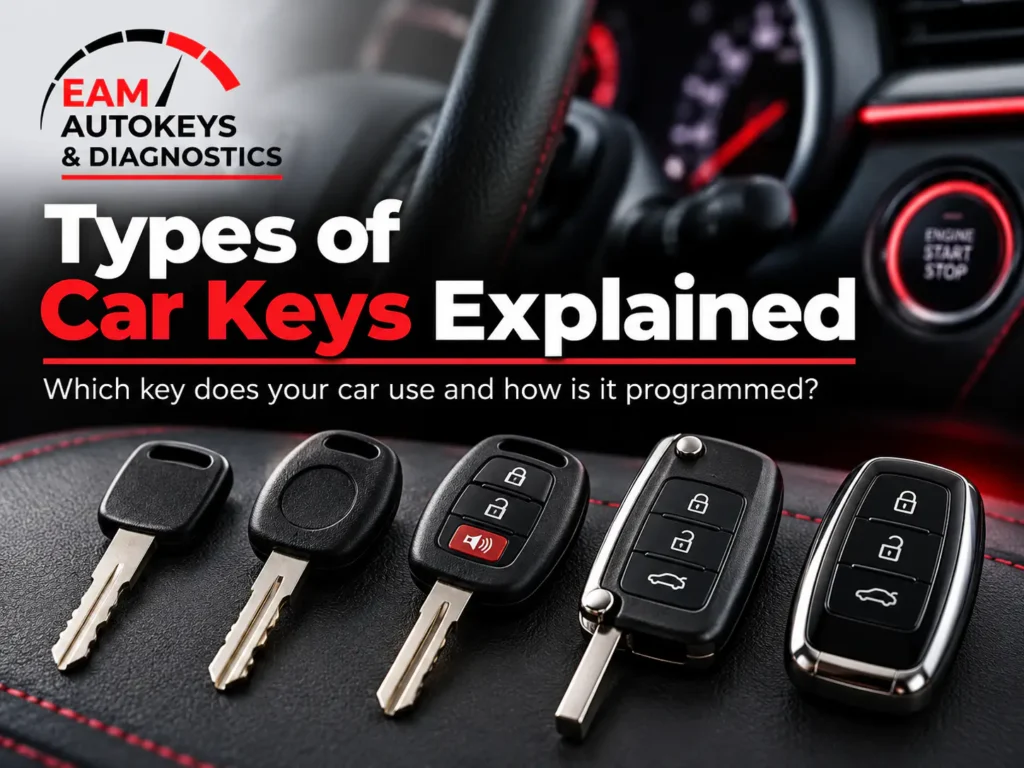
Take your car key, look at it for a second. A simple metal blade? A giant plastic head with buttons? A flip key that flips out or a slick fob that remains in your pocket? That single detail dictates most of what happens when you need a replacement: how long the job takes, what it costs and whether it can be sorted on your driveway in Salford across Manchester or needs a trip to the dealer.
Lost your one and only key? Need a spare programmed?
Please ring EAM Autokeys & Diagnostics on 07354775852.
Our mobile auto locksmiths come to you anywhere in the Greater Manchester area.
We cut and program keys for over 20 manufacturers, from a 2006 Ford Focus with a basic chip key to a current Range Rover with a keyless fob. This guide covers all the different types of car key on UK roads, what’s inside each type, how it communicates with your car and what you can expect from each brand when a key needs replacing.
Why the Type of Key Matters
A car key has two distinct functions. The mechanical bit, the blade, turns the door lock and the ignition barrel on older cars. The electronic side tells the car that this key belongs to it and on most modern keys it also locks and unlocks the doors remotely.
Some keys do only the first job. And most do both. Smart keys handle the electronic part for you, though almost all still contain a small emergency blade inside.
If you lose or break a key, you may need to do something about all those functions. A new blade is cut. The immobilizer works with a new chip. The remote is programmed to the central locking. Miss one step and you get a key that will open the door but won’t start the engine. That’s one of the most common calls we get.
What Is Inside a Modern Car Key?
Open up a typical remote key and you will find four parts.
The blade: Cut to match your door lock and ignition. On keyless cars it is a hidden emergency blade.
The transponder chip: A tiny passive chip, often glass or carbon, that stores security information. It needs no battery. Different manufacturers use different chip families. Volkswagen Group cars have long used Megamos chips, Hitag 2 (often called ID46) turns up across Vauxhall, Peugeot, Citroën and Nissan, and Toyota and older Fords commonly used Texas Instruments 4D chips. Newer cars use encrypted chips such as Hitag Pro and Hitag AES.
The remote circuit boar:. Sends a radio signal to lock and unlock the doors, usually on 433MHz in the UK.
The battery: Powers the remote, not the passive transponder chip. Many fobs use a CR2032 or CR2025 coin cell.
Knowing this explains a lot. On many traditional remote keys, a flat battery stops the buttons working but the car will still start because the transponder chip does not need power from the battery. Smart keys work differently, although many have a backup starting procedure when the fob battery runs flat. A damaged chip can cause the opposite problem: the doors unlock but the engine will not start.
The 8 Types of Car Keys
1. Traditional Mechanical Keys
A plain metal key with no chip and no buttons. Since 1 October 1998, every new car sold in the UK has had to have an electronic immobiliser, so you will mainly find purely mechanical ignition keys on older cars and classics. Mechanical keys are also used for some vehicle doors, compartments and trailers.
These are the simplest keys to replace. We can cut one from the key code or decode it from the lock itself, so even with no original the job is usually quick.
2. Transponder (Chip) Keys
The plastic head looks plain, but there is a chip buried inside. When you turn the key, a coil around the ignition barrel powers the chip for a moment and the immobiliser checks its security information. If the car recognises the key, it allows the engine to start. If it does not, the immobiliser prevents starting.
Early transponders used a fixed code. Later ones use encryption, where the car and key exchange security information during authentication. Some fixed-code chips can be cloned onto a new key without touching the car. Many encrypted keys need specialist programming equipment, which is where car key programming comes in.
One possible sign of a transponder problem is an immobiliser warning light and an engine that refuses to start. Depending on the vehicle, the engine may crank without starting or may not crank at all.
3. Remote Head Keys
Blade, chip and lock buttons all moulded into one head. These were everywhere on superminis and family cars through the 2000s and 2010s.
What most people do not realise is that the chip and the remote can operate as two separate systems. A key can start the car perfectly while the buttons do nothing, or the other way round. When we programme a remote head key, we test both before we leave.
4. Flip Keys (Switchblade Keys)
The blade folds into the fob and flicks out at the press of a button. Flip keys are common on Volkswagen, Audi, Skoda, Seat, Peugeot, Citroën, Hyundai and Kia models.
The weak point is the hinge. Springs snap, blades go floppy and cases crack after a few drops on the pavement. If the electronics still work, you often do not need a completely new key.
We can move the circuit board and chip into a new case and fit a freshly cut blade. If the original electronics are transferred correctly and remain functional, no additional programming is normally needed.
5. Separate Key and Remote Fob
Common on older Fords and some commercial vehicles. The key has a chip in the head for starting the engine, and a separate remote hangs on the keyring for central locking.
Each can be replaced on its own, which often makes this setup cheaper to fix than an all-in-one key.
6. Smart Keys (Proximity, Keyless Entry and Push-Button Start)
Keep it in your pocket. Walk up and the doors unlock. Press a button and the engine starts. The car communicates with the nearby fob and allows entry or starting when it recognises the correct key.
Smart keys are fitted to many newer Toyota, Lexus, Land Rover, Mercedes-Benz, BMW, Hyundai and Kia models, and many more.
Programming them is usually more involved than a basic chip key. On some models, if every key has been lost, the security module has to be read directly on the bench rather than through the diagnostic port.
They also bring a theft risk. In a relay attack, thieves use devices to relay signals between your key and the car, making the vehicle think the key is nearby.
A properly functioning signal-blocking Faraday pouch can help protect against this type of attack. Some manufacturers also let you switch off keyless entry in the car’s settings or with a button sequence on the fob, so check your handbook.
Several newer models use ultra-wideband technology to measure the distance between the key and the car more accurately, making traditional relay attacks harder.
7. Key Cards
Renault took a different route. Many Mégane, Scénic, Laguna and Clio models use a flat card instead of a fob.
On some you slot it into a reader on the dashboard. On hands-free versions it stays in your pocket. Many cards also contain a small emergency blade for unlocking the door if the battery dies.
Card readers do fail, and when they do the car often shows a “card not detected” message. Sometimes the card is fine and the reader is at fault. We diagnose which one before replacing anything.
8. Digital and Phone-Based Keys
A growing number of cars let your phone act as the key, including some BMW, Hyundai, Kia and Tesla models.
Depending on the vehicle, a digital key may work through a manufacturer app, NFC, Bluetooth or ultra-wideband technology.
Many vehicles also support a physical key card or fob as an alternative, although the available backup options vary by model.
If your car relies on a phone key, ring us first and we will tell you whether it is a job we can do.
Blade Types: Edge Cut, Laser Cut and Tibbe
The electronics get most of the attention, but the blade matters too.
Edge-cut blades have the familiar jagged teeth along one or both edges. Standard key-cutting machines can handle many of them.
Laser-cut blades, also called high-security or track-cut blades, are typically thicker, with a groove milled into the face of the blade rather than teeth on the edge. They need a suitable specialist cutting machine, so not every high street key counter can copy them.
Tibbe keys have a distinctive cylindrical design and are found on older Fords and Jaguars. They need specific cutting equipment, which a suitably equipped mobile auto locksmith can use.
How to Tell Which Key You Have
| What you see | Most likely key type |
| All-metal key, no plastic head | Mechanical key, often on an older vehicle |
| Plastic head, no buttons | Transponder chip key |
| Buttons and a fixed blade in one piece | Remote head key |
| Blade folds out at the press of a button | Flip key |
| Chip key plus a separate remote on the keyring | Separate key and fob |
| No visible blade, push-button start in the car | Smart or proximity key |
| Flat card, Renault badge | Key card |
| Phone app unlocks the car | Digital key |
Still not sure? Send a photo of your key on WhatsApp with your registration and we will tell you what it is.
Signs Your Key Needs Repair, Reprogramming, or Replacing
Different symptoms point to different possible fixes, and knowing which can save you money.
Buttons work intermittently, or the range has dropped: The battery is a good place to start. Change it before considering more expensive repairs.
Buttons dead, new battery fitted, car still starts: The remote may have lost synchronisation, or the circuit board could be damaged. It may need reprogramming or repair rather than a full replacement.
Doors unlock, but the engine will not start, immobiliser light flashing: The car may not be recognising the transponder chip. However, immobiliser faults, wiring problems, and other vehicle issues can cause similar symptoms, so diagnosis is important.
Blade loose, case cracked, flip mechanism broken: A new case and blade may solve the problem if the existing electronics still work.
Key snapped in the lock or ignition: Do not try to dig it out with a screwdriver. We can extract broken keys using specialist tools and cut a replacement.
Key worn smooth, sticking in the ignition: A worn blade can cause problems with the ignition barrel over time. Getting a correctly cut replacement before it becomes worse may prevent further damage.
Every key lost or stolen: A new key may need to be cut and programmed from scratch, with missing keys removed from the vehicle’s authorised key list where supported. See our lost or stolen car keys service.
Car Brands We Cover and What Is Different About Each

Every manufacturer builds its security a little differently. Here is what we see day to day.
BMW
BMW keys depend on the car’s security module. Older E-series models use the CAS unit, while many F-series and G-series cars use newer modules such as FEM and BDC.
For a new key, the programming method depends on the module and its security system. Some jobs require reading security data from the vehicle before preparing a compatible key.
Comfort Access fobs and display keys on supported models may also need specialist procedures.
Mercedes-Benz
Mercedes keys are among the more complex ones to programme. Earlier models using the FBS3 system can often be handled by a suitably equipped locksmith.
On many models from roughly 2015 onwards, the newer FBS4 system can require a manufacturer-authorised replacement process or a key supplied specifically for the vehicle.
We check your car and tell you which route applies before you spend anything.
Volkswagen, Audi, Skoda and Seat
The Volkswagen Group shares immobiliser technology across its brands, so a Skoda Octavia and a VW Golf of the same era may use similar programming methods.
Flip keys are common here. Cars built on the MQB platform, such as the Golf Mk7, Octavia Mk3 and Audi A3 8V, need specialist equipment and security access. Some newer models with keyless entry need additional steps.
Porsche and Bentley
Both sit within the Volkswagen Group and use advanced vehicle security systems.
We assess these case by case. On some models we can programme a key on site. On others, a dealer-supplied key may be needed, and we will say so up front.
Land Rover and Range Rover
Keyless entry is common on modern Range Rover, Discovery and Evoque models.
Older models such as the Freelander 2 can often be programmed using established locksmith procedures. Newer models use more advanced security systems and may require updated equipment and additional authorisation.
If your vehicle has keyless entry, consider storing the fob in a tested Faraday pouch when it is not in use.
Ford
Ford’s PATS immobiliser covers models including the Fiesta, Focus and Transit.
Older Fords may use Tibbe blades or a separate remote. Newer models have flip keys or keyless fobs.
Transits are a big part of our work, because a van off the road means a tradesperson off work.
Toyota and Lexus
Many newer Toyota and Lexus models use smart keys with push-button start, including hybrid vehicles.
Adding a key is often more straightforward when you already have a working one. All-keys-lost situations on newer models can require additional security procedures.
Depending on the vehicle, a mobile locksmith may still be able to complete the job without taking the car to a dealer.
Honda, Nissan, Mazda and Mitsubishi
These Japanese manufacturers use a range of transponder, remote head, and smart key systems, depending on the model and year.
Some Nissan models require security PIN access during programming. Mazda and Mitsubishi systems vary too, so we check the specific vehicle before choosing the programming method.
Hyundai and Kia
The Tucson, Sportage and i-series are common around Greater Manchester.
Older models often use remote or flip keys, while newer vehicles may use smart keys.
Many models use PIN-based programming or other security authorisation procedures. The exact method depends on the vehicle’s generation and security system.
Peugeot, Citroën and Jeep
All are now part of the Stellantis group, although their security systems vary by model and year.
Peugeot and Citroën flip keys are common, and many models use a body systems interface (BSI) that stores important security information.
Some recent Stellantis vehicles have secure gateway systems that require additional access procedures.
Renault and Smart
Renault key cards are covered above.
Smart is a less obvious pairing. Some ForTwo and ForFour generations share platform technology with the Renault Twingo, so their keys use related systems.
Older Smart models have their own programming requirements, which we also assess.
Your make not listed? That does not mean we cannot help. Vauxhall, Volvo, Fiat, and others are regular jobs too. Call with your registration, and we will confirm on the phone.
What Affects the Cost of a Replacement Key
We give a fixed quote before starting, and these are the factors that affect the price:
- Key type. A basic chip key generally costs less than a smart fob with keyless entry.
- Make, model, and year. Premium and newer models may need more advanced equipment and expensive key blanks.
- Add a key or all keys lost. Adding a spare is usually cheaper than replacing every missing key.
- Blade type. High-security blades may require specialist cutting equipment.
- Module work. If a module has to be removed and read on the bench, the job takes longer.
- Time and location. Out-of-hours and roadside call-outs can affect the price.
For an accurate price, contact EAM Autokeys & Diagnostics with your registration number, key type and location.
Auto Locksmith or Main Dealer?
If every key is lost, a main dealer may need the car brought to them, which can mean paying for a recovery truck. The key may then need to be ordered from the manufacturer.
A mobile auto locksmith comes to the car. Many replacements can be cut and programmed in the same visit, depending on the vehicle and key system.
A mobile locksmith may also cost less than a main dealer, particularly when you can avoid vehicle recovery charges. However, prices vary by make, model and the work required.
There are exceptions. Some very new or high-security models still need a dealer-sourced key or manufacturer-authorised programming process.
When that happens, we will explain the available options before starting the job.
What to Have Ready When You Call
Having these to hand speeds things up:
- Your registration number, plus the make, model and year
- Whether you have a working key
- Where the car is, ideally a postcode
- Your V5C logbook and photo ID
That last one matters. Expect a reputable locksmith, us included, to check that you are authorised to request a key for the vehicle.
If your logbook is missing, you can apply for a replacement V5C on GOV.UK.
Habits That Save You Money
Make a spare while you still have a working key. It’s usually cheaper to add a key than it is to do an all-keys-lost job, and a spare key can save you from an unexpected breakdown or recovery bill.
Replace the battery in the fob when the range begins to decrease, or the buttons fail to function properly. $ Replacement coin cell is inexpensive and might solve the problem without further repairs.
If your car is equipped with keyless entry, keep the fob away from doors and windows and consider a tested Faraday pouch.
Don’t forget to check your car insurance policy as well. Some policies include key cover. This can help cover the cost of replacing lost or stolen keys.
Need a Key Cut or Programmed?
Whatever is on your keyring, whether it is a chip key, flip key, smart fob or key card, we can usually sort it where your car is parked.
Call EAM Autokeys & Diagnostics on 07354775852, message us on WhatsApp, or book online.
Locked out with the key still inside?
Our emergency car opening service can help you get back in. If you are in Bolton, our lost car keys Bolton guide explains what to do next.